Partner Catulle Mendès
Queer Places:
Cimetière Saint Louis, 8 Rue Mgr Gibier, 78000 Versailles, France
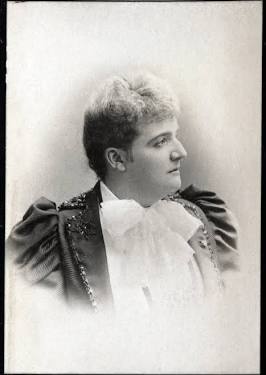 Augusta Holmès (December 16, 1847 – January 28, 1903) was one of the most ambitious, flamboyant, and boundary-pushing composers of 19th-century France. In a musical era that
expected women to limit themselves to delicate piano pieces and intimate parlor songs, Holmès "thought big". She composed sweeping programmatic symphonies, politically
charged symphonic poems, and grand operas, forcefully claiming a space in a fiercely patriarchal art form.
Augusta Holmès (December 16, 1847 – January 28, 1903) was one of the most ambitious, flamboyant, and boundary-pushing composers of 19th-century France. In a musical era that
expected women to limit themselves to delicate piano pieces and intimate parlor songs, Holmès "thought big". She composed sweeping programmatic symphonies, politically
charged symphonic poems, and grand operas, forcefully claiming a space in a fiercely patriarchal art form.
Born in Paris to Irish parents, Augusta Mary Anne Holmès was rumored to actually be the biological daughter of her godfather, the French Romantic poet Alfred de Vigny.
Her mother vehemently opposed her interest in music, completely forbidding her from studying it. It wasn't until her mother’s death in 1858 that Augusta was finally
allowed to take formal music lessons.
Even then, institutional sexism blocked her path: she was barred from studying at the prestigious Paris Conservatoire because of her gender. Undeterred, she studied
privately, mastering orchestration, harmony, and voice. To get her early compositions published and performed without immediate dismissal, she used the male pseudonym
Hermann Zenta.
By 1875, Holmès was a central force in Parisian salon life. She became a beloved student of César Franck (who, along with
Camille Saint-Saëns, was deeply infatuated with her) and was highly encouraged by Franz Liszt.
Holmès wrote her own lyrics and librettos, heavily influenced by her idol Richard Wagner. Some of her greatest career
highlights include:
Irlande (1882) & Pologne (1883): Highly successful nationalist and political symphonic poems.
Ode triomphale (1889): A massive cantata commissioned for the Paris World’s Fair (celebrating the centennial of the French Revolution) that required over 1,200
musicians.
La Montagne Noire (1895): One of the very few operas composed by a woman to be produced at the Paris Opéra during the 19th century.
Augusta Holmès is a deeply significant figure in queer musicology and LGBTQ+ history. Her life, career, and legacy intersected with queer themes in several fascinating
ways:
The most direct LGBTQ+ link to Holmès is through Dame Ethel Smyth, the famous, openly bisexual/lesbian English composer and
suffragette.
Smyth deeply admired Holmès, viewing her as an essential queer-adjacent role model. Smyth wrote a famous, highly affectionate biographical essay about her titled
"Augusta Holmes, Pioneer" (published in her 1928 book A Final Burning of Boats). For Smyth, Holmès was proof that a woman could bypass traditional domestic expectations,
live independently, and write massive, complex orchestral works. Smyth's own artistic boldness was heavily modeled on Holmès’s blueprint.
In 19th-century Europe, musical composition was heavily gendered. Women were expected to write "feminine" music—gentle, small-scale, and emotional. Holmès aggressively
shattered these boundaries by writing loud, brassy, and complex orchestrations.
Male critics of her era did not know what to do with her. They frequently described her music as "virile," "masculine," and "devoid of female affectation". Saint-Saëns
famously criticized her "excessive virility".
Musicologists note that Holmès actively leaned into this "gender-bending manipulation of ambiguities". By publishing under a male name early on, and later commanding huge
orchestras of hundreds of men, she refused to play the role of the traditional 19th-century woman, carving out an almost androgynous, larger-than-life persona in the public
eye.
Holmès's personal life was completely scandalous by Victorian-era standards. When her father died, she became the sole heir to his fortune, which gave her complete
financial independence.
She never married. Instead, she cohabitated openly for nearly two decades with the poet Catulle Mendès (who was legally
married to the writer Judith Gautier). Holmès had five children with Mendès out of wedlock. Because she prioritized her career
over motherhood, the children were raised entirely by a caretaker.
Her domestic arrangement was remarkably bohemian and detached from heterosexual norms. In a bizarre twist of fate, Mendès's wife, Judith Gautier, had her own passionate
affairs—most notably with Holmès’s idol, Richard Wagner.
Augusta Holmès passed away in 1903. Though her grand works fell out of fashion in the mid-20th century, modern musicology has thoroughly reclaimed her. She is celebrated
today not just for her brilliant, thunderous compositions, but as a queer feminist icon who refused to let the rigid gender roles of her time dictate how she lived, loved,
or wrote music.
References:
Other references:
- https://en.wikipedia.org/wiki/Augusta_Holm%C3%A8s
- https://www.dib.ie/biography/holmes-augusta-mary-anne-a4065
- https://www.coreliaproject.org/composers/holm%C3%A8s/augusta
Support this project
This website is a passion project researched, developed, and funded entirely by me. If you find the content valuable and would like to help support the ongoing research and hosting costs, any contribution is deeply appreciated.
Thank you for keeping this independent resource alive!
My books on Amazon: Elisa Rolle's books
BACK TO HOME PAGE
